

Finding Your Way Around the Secure AI Framework Without Getting Lost
Why Every Business Leader Needs a Secure AI Framework Right Now
Quick answer: A secure AI framework is a structured set of principles, controls, and processes that help organizations build, deploy, and operate AI systems safely. The most widely referenced example is Google’s Secure AI Framework (SAIF), which organizes AI security around six core elements:
- Expand strong security foundations to your AI ecosystem
- Extend detection and response to cover AI-specific threats
- Automate defenses to keep pace with evolving attacks
- Harmonize platform-level controls across your organization
- Adapt controls with faster feedback loops as threats change
- Contextualize AI system risks within your broader business processes
Other key frameworks include the NIST AI Risk Management Framework (AI RMF 1.0), released January 26, 2023, and the MIT Sloan Secure-by-Design model, which condenses AI security into 10 strategic executive questions.
AI is moving fast. And for most businesses, security is not keeping up.
The core problem is this: AI systems are fundamentally different from traditional software. They depend on massive datasets, learn continuously, and produce probabilistic outputs. That means threats like data poisoning, prompt injection, and model theft cannot simply be patched after deployment. As one MIT Sloan analysis puts it, AI risks must be designed out from the start — not bolted on later.
For a Houston manufacturer, a regional bank, or a law firm running AI-assisted workflows, the stakes are real. A compromised AI model does not just crash a server — it can corrupt decisions, leak confidential data, or silently behave in ways no one intended.
This guide walks you through the major secure AI frameworks available today, how they compare, and what practical steps your organization can take to close the gaps.
I’m Roland Parker, Founder and CEO of Impress Computers, a managed IT services and cybersecurity firm serving businesses across the Houston area since 1993, and author of Mastering AI: How Business Leaders Can Harness the Power of Artificial Intelligence. Over more than three decades helping manufacturers, construction firms, and professional services organizations secure their technology, I’ve watched the secure AI framework conversation move from niche academic topic to urgent business priority.
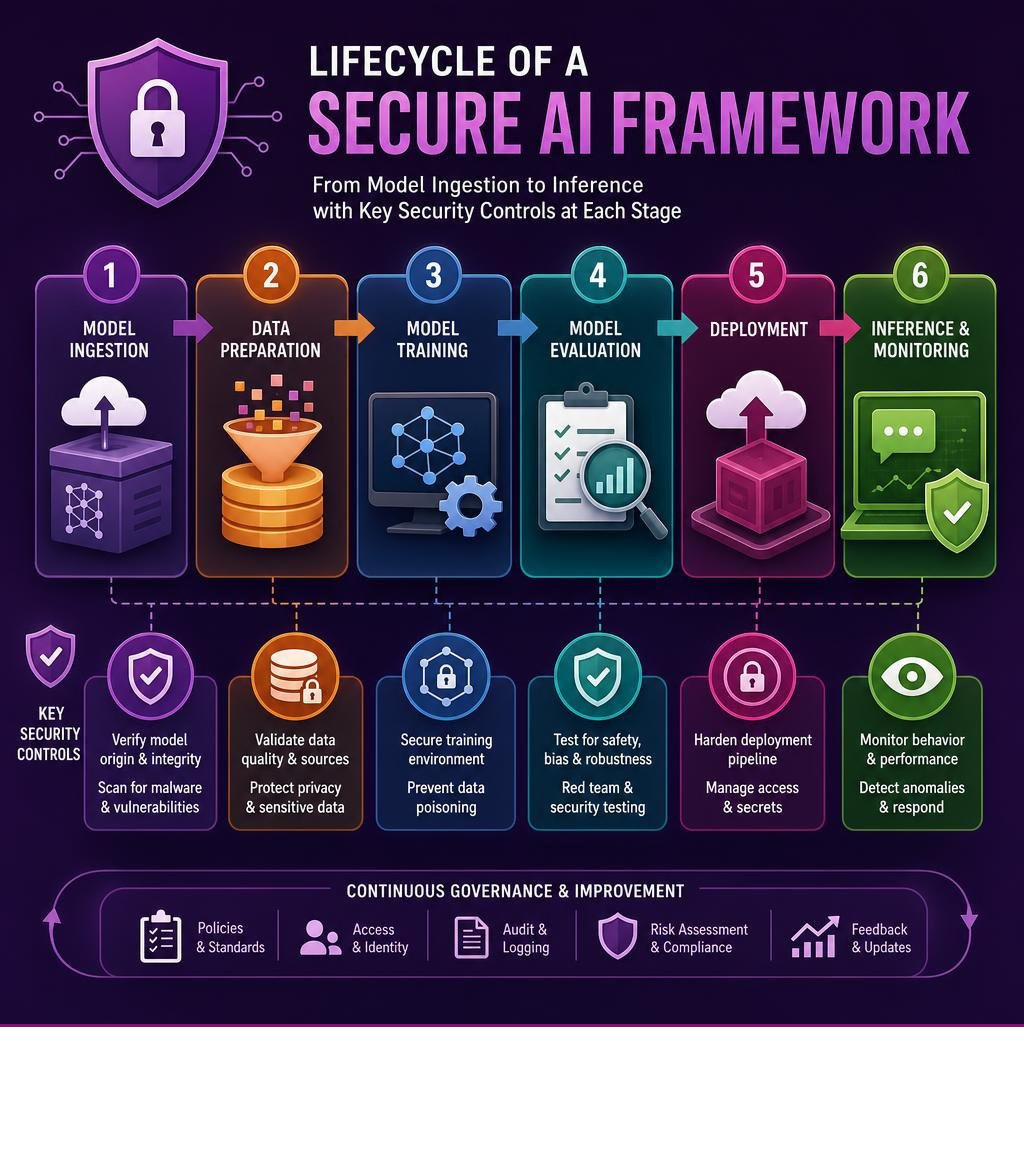
Secure ai framework terms to learn:
Demystifying Google’s Secure AI Framework (SAIF)
When businesses in Katy, Sugar Land, and across the Greater Houston area ask how to structure their defensive posture, we frequently point them toward Google’s Secure AI Framework (SAIF). This conceptual framework is designed to bridge the gap between traditional IT security and the unique, often opaque risks of machine learning.
Crucially, SAIF does not exist in a vacuum. It is built to align directly with the security and privacy dimensions of broader Responsible AI principles. While Responsible AI covers critical societal concepts like fairness, interpretability, and bias mitigation, SAIF focuses on the operational reality of keeping those systems secure and private. It provides a practical, risk-based roadmap designed to help security teams defend machine learning models and the infrastructure supporting them.
Core Elements of a Secure AI Framework
Google’s SAIF is built upon six core elements that address the entire lifecycle of machine learning development and operations:
- Expand strong security foundations: Traditional cybersecurity controls—like firewalls, identity and access management, and vulnerability scanning—must extend to the AI ecosystem. You cannot secure an AI model if the server hosting it or the database feeding it is left wide open.
- Extend detection and response: Organizations must bring AI-specific threats into their existing security operations center (SOC) and threat universe. This means monitoring for anomalous query volumes, prompt injection attempts, and unauthorized model exports.
- Automate defenses: To keep pace with automated and rapidly evolving threats, security teams must automate defensive controls. This includes automated scanning of training pipelines and real-time input filtering.
- Harmonize platform-level controls: Security policies should be consistent across all development platforms. Whether your team is building models in-house or consuming third-party APIs, a unified control plane ensures that no “shadow AI” deployments bypass security oversight.
- Adapt controls: AI systems change constantly as they ingest new data. Security controls must adapt dynamically, using faster feedback loops, continuous testing, and red-teaming exercises to adjust mitigations as model behaviors evolve.
- Contextualize AI system risks: Not all AI applications carry the same level of risk. An internal AI tool used by a Houston construction firm to summarize safety manuals requires different security boundaries than an AI-driven loan-approval system at a bank in Katy. Security measures must always be contextualized based on the business process the AI supports.
To explore how these elements translate into real-world architectures, you can review our guide on The Best Services for Secure Machine Learning Deployment and Auditing.
Aligning SAIF with NIST AI RMF and Responsible AI
While SAIF provides a highly practical, engineering-focused framework, many regulated industries in Houston—such as banking, legal, and CPA firms—require alignment with federal standards. This is where the NIST AI Risk Management Framework (AI RMF 1.0) comes into play. Released on January 26, 2023, the NIST AI RMF was developed through a consensus-driven, transparent process to help organizations manage risks to individuals, organizations, and society.
To address the rapid rise of large language models, NIST released the Generative AI Profile (NIST-AI-600-1) on July 26, 2024. This profile acts as a specialized guide, helping organizations identify unique risks posed by generative AI and mapping them to actionable risk management steps.
Rather than choosing between SAIF and the NIST AI RMF, smart organizations use them in tandem. SAIF provides the technical “how-to” for cloud and on-premises infrastructure, while the NIST AI RMF offers the governance and compliance structure required by boards and regulatory bodies. For a deeper look at aligning these frameworks with your development pipeline, read our detailed analysis on Compliance or Chaos: Securing Your Machine Learning Pipelines.
Identifying Critical AI-Specific Security Risks and Vulnerabilities

Before you can implement a secure AI framework, you must understand the threat landscape. Traditional threat modeling frameworks, such as STRIDE, remain highly valuable for securing the underlying network, APIs, and host operating systems. However, they must be supplemented with AI-specific knowledge bases like MITRE ATLAS (Adversarial Threat Landscape for Artificial-Intelligence Systems) and the OWASP Top 10 for LLMs.
AI systems introduce unique vulnerabilities because they rely on probabilistic calculations rather than deterministic code. If you input a specific command into traditional software, it executes exactly as programmed. If you input a prompt into an LLM, the model calculates the most likely next word based on its training. This fundamental difference opens the door to entirely new classes of attacks.
Data Poisoning, Model Theft, and Prompt Injection
Three of the most critical risks that organizations must address include:
- Data Poisoning: This occurs when an attacker manipulates the training data or fine-tuning datasets used to build an AI model. By inserting malicious or biased information into the pipeline, the attacker can force the model to make incorrect predictions or create hidden backdoors. For example, a poisoned model used by a manufacturer in Brookshire might be manipulated to ignore specific equipment defects during quality control.
- Model Theft and Inversion: Machine learning models represent significant intellectual property and development cost. Attackers can use repeated, highly targeted queries to reconstruct the architecture and weights of a proprietary model (model theft) or reverse-engineer the training data to extract sensitive, private information (model inversion).
- Prompt Injection and Evasion Attacks: Prompt injection involves crafting inputs that trick an LLM into ignoring its system instructions and executing unauthorized commands. In evasion attacks, adversaries subtly modify input data (such as adding imperceptible noise to an image) to deceive a classification model into making a false prediction.
To learn how to audit your supply chain against these specific vectors, read our guide on how to Get Your Secure AI, Privacy Compliance, and Supply Chain Audit Done Right.
The Unique Security Challenges of Autonomous AI Agents
As organizations move from passive chatbots to active, autonomous AI agents, the security challenges multiply. Unlike static models, autonomous agents are designed to execute multi-step plans, call external APIs, read databases, and write files without human intervention.
This autonomy exposes them to what security researchers identify as a critical combination of three risk factors in AI security:
- Access to Private Data: The agent has permission to read sensitive internal databases, emails, or system files.
- Untrusted External Content: The agent is allowed to ingest untrusted data from the outside world, such as scraping a public website, reading incoming customer emails, or querying a third-party API.
- An Exfiltration Sink: The agent has the capability to write data to an external location, such as sending an outbound API call, posting a public Slack message, or writing to an external database.
When these three factors exist together, an attacker can exploit the agent via indirect prompt injection. For instance, an attacker could place a hidden instruction on a public webpage. When the autonomous agent scrapes that page, the hidden instruction hijacks the agent’s execution flow, ordering it to gather the user’s private data and transmit it to the attacker’s external server.
To mitigate these risks, developers are turning to deterministic information-flow control frameworks. You can read more about these emerging security patterns in the official documentation on Agent Security with FIDES | Microsoft Learn.
Practical Steps to Implement a Secure AI Framework

Implementing a secure AI framework is not a one-time project; it is a continuous, iterative lifecycle. For businesses operating in highly competitive Texas markets like Katy, Richmond, and The Woodlands, deploying AI safely requires a structured, step-by-step approach.
Assembling a Cross-Functional Team and Aligning Expectations
The first step in any AI security initiative is to build a multidisciplinary team. Because AI systems are complex, resource-intensive, and can generate novel content that impacts legal and compliance postures, you cannot leave AI security solely to the IT department. Your cross-functional team should include:
- Security and IT Professionals: To manage cloud infrastructure, access controls, and network monitoring.
- Data Scientists and ML Engineers: To oversee model selection, training, and pipeline integrity.
- Compliance and Legal Counsel: To evaluate data privacy, intellectual property risks, and industry-specific regulations.
- Business Unit Leaders: To define the specific business problems the AI will solve and verify that the technology aligns with operational goals.
Once the team is assembled, conduct an “AI Primer” session. It is vital that all stakeholders—especially non-technical executive leaders—understand the basic machine learning development lifecycle, as well as the capabilities and limitations of the models being deployed. To help align your team’s technical stack with compliance standards, consult our guide on The Best AI Security Compliance Services for Your Tech Stack.
Implementing a Secure AI Framework in Enterprise Environments
Once your team is aligned, you can begin applying the core elements of your chosen framework. In practical enterprise environments, this involves establishing a strong governance structure and deploying technical boundaries:
- Establish an AI Asset Inventory: You cannot secure what you do not know exists. Use automated scanning tools to discover and catalog all AI models, datasets, and API integrations across your network.
- Define Strict Data Boundaries: Implement Role-Based Access Control (RBAC) to ensure that AI workloads and models can only access the specific datasets they require.
- Isolate AI Communications: Use private endpoints and virtual networks (such as VPCs) to isolate sensitive AI resources and prevent data from traversing the public internet.
- Implement Data Loss Prevention (DLP): Configure content filters to automatically detect and redact sensitive data (such as PII, financial records, or proprietary source code) before it is sent to external model APIs.
For real-world examples of how these controls are deployed to protect operational technology and documentation workflows, read our recap on How Manufacturers Use Secure AI to Cut Downtime and Simplify Documentation Webinar Recap.
Executive Governance and the MIT Sloan 10-Question Model
For C-suite executives and board members, diving deep into technical code is rarely practical. Instead, executives need structured governance frameworks to align AI security with business strategy. The MIT Sloan Secure-by-Design AI framework serves this exact purpose, condensing hundreds of technical considerations into 10 strategic questions:
- How does this AI initiative align with our organizational objectives, budget, values, and ethics?
- What methodologies are we using to identify, assess, and prioritize AI-specific risks?
- What specific controls and tools will we implement to mitigate those identified risks?
- What policies are in place to ensure data quality, privacy, ethics, and cybersecurity?
- What governance structure will oversee AI project development, deployment, security, and operations?
- Is the proposed AI architecture fully compatible with our existing IT infrastructure?
- What level of security budget and personnel effort is required, and how will we allocate resources?
- What metrics will we use to track AI effectiveness and security posture?
- What mechanisms will support ongoing monitoring and adaptation of our AI systems?
- How will we communicate the importance of AI security, privacy, and ethics to foster shared responsibility across the company?
Asking these questions early in the design phase prevents costly security redesigns later. To understand the broader regulatory landscape and why proactive governance is critical for Texas businesses, read this guest commentary on how Missouri missed chance to regulate Big Tech and AI dangers, which highlights the growing pressure on organizations to self-regulate responsibly.
Advanced Technical Controls and Open-Source Security Testing
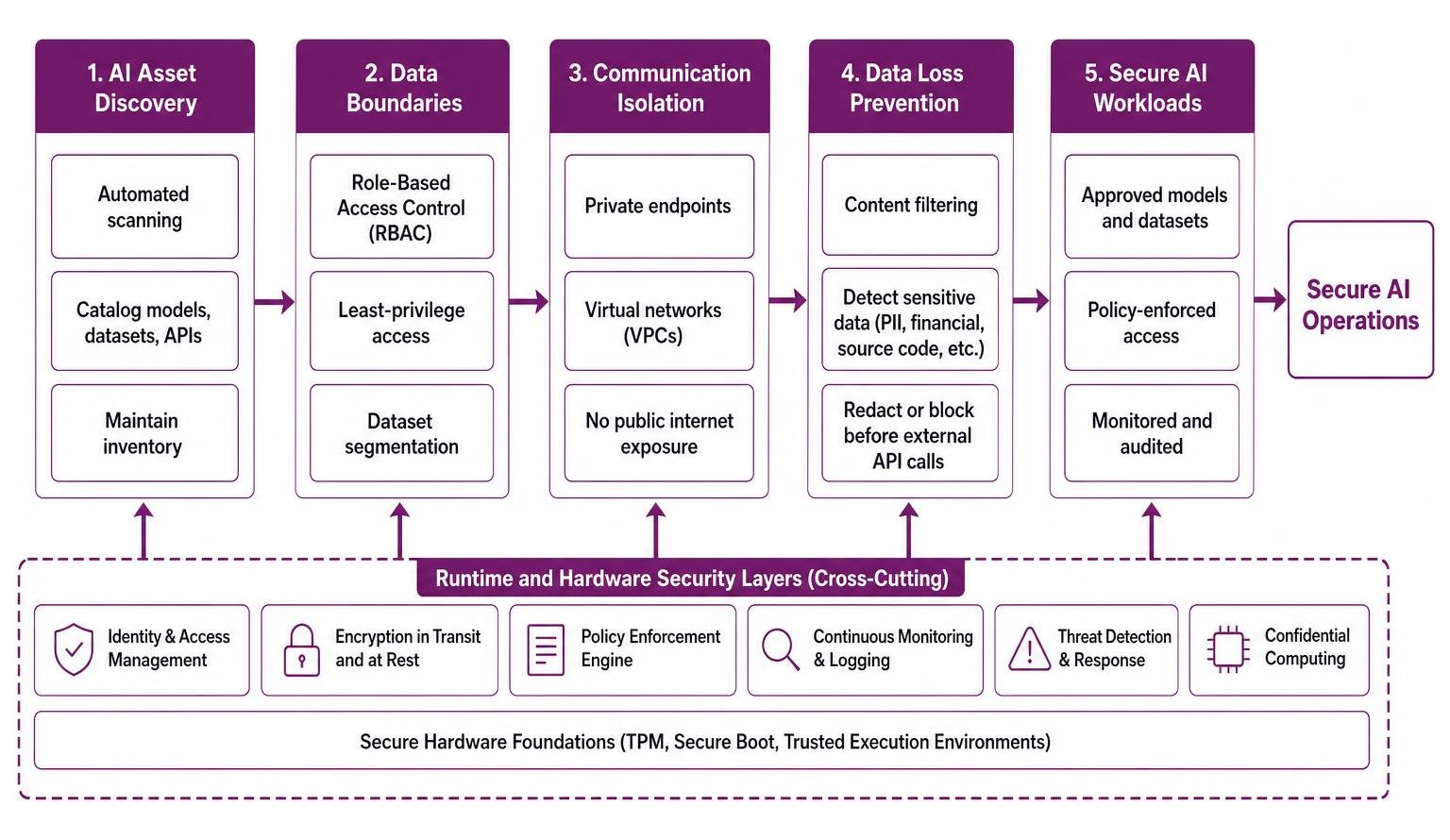
As AI deployments mature, organizations must move beyond high-level policy and implement advanced technical controls at the runtime and hardware levels.
Cloud-Native Controls and Confidential Computing
Major cloud providers offer specialized tools designed to mitigate unique AI risks. In the Google Cloud ecosystem, for example, key controls include:
- VPC Service Controls: These allow you to define a security perimeter around sensitive data and Vertex AI services, mitigating the risk of unauthorized data exfiltration.
- Model Armor: This service acts as an inline inspection and routing tool, filtering foundation model prompts and responses in real time to block prompt injection, jailbreaks, and sensitive data leakage.
- Confidential Computing: This technology leverages hardware-based security to protect data while it is actively being processed in memory. By extending these protections from CPUs to advanced GPUs (such as NVIDIA H100s), Confidential AI ensures that sensitive training datasets and model weights remain encrypted even during active training and inference.
For organizations running autonomous agents on-premises or in hybrid environments, open-source runtime enforcement tools like EnforceCore provide a critical control layer. Operating at the runtime boundary, these tools enforce hard security policies—such as mandatory PII redaction and resource constraints—at every external call boundary, ensuring that even if an agent is compromised, it cannot execute unauthorized system commands.
Leveraging Open-Source Frameworks for Adversarial Testing
Securing an AI system requires active validation. Red teaming and adversarial testing involve simulating real-world attacks to discover hidden vulnerabilities before malicious actors do.
To automate and scale these security assessments, organizations can leverage powerful open-source frameworks:
- Cybersecurity AI (CAI): Available via the aliasrobotics/cai repository, CAI is a lightweight framework built for offensive and defensive security testing. It supports over 300 AI models from providers like OpenAI, Anthropic, DeepSeek, and Ollama. In standardized benchmark evaluations, CAI-powered security testing demonstrated a documented 3,600× performance improvement over human penetration testers. It also achieved a Top-10 ranking in the Dragos OT CTF 2025, maintaining a 37% velocity advantage over top human teams. CAI has been used to discover critical vulnerabilities (ranging from CVSS 4.3 to 7.5) in production systems, including exposed RSA keys and unauthorized telemetry transmissions in humanoid robots.
- Nucleus: Found at coproduct-opensource/nucleus, this framework focuses on zero-trust verification. It assumes the AI agent is already compromised and uses formal mathematical verification and information-flow control (IFC) to guarantee that tainted data can never reach a privileged action or exfiltration sink.
- Tessera: Accessible via kenithphilip/Tessera, this library provides deterministic security primitives, including signed trust labels and dual-LLM execution patterns, to protect agent architectures from indirect prompt injection.
- SecAI OS: For highly secure, local AI deployments, the GitHub – SecAI-Hub/SecAI_OS at d93400b932a3b5c68ec149f125d18f7cce894fbf · GitHub repository offers an immutable operating system foundation. It features a default-deny network egress policy and an automated 7-stage quarantine pipeline designed to scan, verify, and safely ingest untrusted open-source AI models.
When comparing AI security testing to traditional software verification, it is helpful to note how specialized these tools are. While a web application developer might use standard JavaScript frameworks like Cypress to test user interfaces and API endpoints, securing machine learning requires these specialized, adversarial AI tools to validate probabilistic behaviors and model boundaries.
Building a Collaborative Security Community with CoSAI
Because the AI threat landscape evolves daily, no single organization can solve these security challenges alone. To foster industry-wide collaboration, leading technology companies formed the Coalition for Secure AI (CoSAI).
With founding members including Anthropic, Cisco, IBM, Intel, Nvidia, and PayPal, CoSAI works to create standardized secure deployment guidelines, share threat intelligence, and establish common benchmarks. Participating in these collaborative communities helps organizations of all sizes stay ahead of emerging threats and deploy AI technologies with confidence.
Frequently Asked Questions About Secure AI Frameworks
What is the difference between SAIF and the NIST AI RMF?
SAIF is a highly technical, practitioner-focused framework developed by Google that details specific infrastructure controls, cloud configurations, and engineering practices. The NIST AI RMF 1.0 is a voluntary, consensus-driven federal framework that provides high-level governance, risk prioritization, and organizational guidelines. SAIF tells you how to secure the technology, while the NIST AI RMF helps you govern the process and demonstrate compliance to stakeholders.
How do you protect AI agents from indirect prompt injection?
Protecting autonomous agents requires moving away from soft, prompt-based filters. Instead, implement deterministic controls such as:
- Taint Tracking: Labeling all incoming data with cryptographic trust tags and blocking privileged tools if untrusted data is in the context window.
- Dual-LLM Execution: Using a high-trust model to plan tasks and a sandboxed, low-trust model to process untrusted data.
- Human-in-the-Loop (HITL) Gates: Requiring manual approval for high-risk actions like file deletion or outbound financial transactions.
Why are traditional string-matching guardrails insufficient for LLMs?
Traditional guardrails act like simple firewalls, searching for specific blacklisted words or phrases. Because LLMs process natural language probabilistically and concatenate system instructions and user inputs into a single, undifferentiated context, attackers can easily bypass simple filters using creative paraphrasing, translation, or obfuscation. True AI security must be enforced at the runtime and data-flow boundaries, not inside the prompt itself.
Conclusion
Navigating the complexities of a secure AI framework can feel overwhelming, but you do not have to do it alone. At Impress Computers, we provide comprehensive managed IT services, advanced cybersecurity, and industry-specific expertise tailored for businesses across Houston, Katy, Sugar Land, Cypress, and The Woodlands.
Whether you operate a manufacturing facility in Brookshire, a law firm in Richmond, or a financial institution in Fulshear, we back our services with a 15-minute response guarantee and 99.9% uptime.
Ready to secure your business’s machine learning pipelines and ensure compliance? Contact us today to learn about our Secure AI Training and Implementation Program and take the first step toward safe, responsible AI deployment.
